Air Conditioning Industry Regulations
Stay up-to-date with the latest news in air conditioning industry regulations.
What are the latest HVAC efficiency and refrigerant regulatory changes?
The HVAC industry is preparing for the next round of refrigerant and efficiency regulations for air conditioning and heat pumps. Although the industry has a significant amount of experience in increasing efficiency and transitioning to new refrigerants, the timing and uncertainty have made this regulatory cycle more complex.
Copeland is a global leader in sustainable heating, cooling and cold chain solutions. The two ebooks below help customers prepare for the changes.


What is the Kigali Amendment to the Montreal Protocol?
Most people associate the Montreal Protocol with phasing out ozone-depleting substances. The Montreal Protocol has also evaluated the global warming potential of HFCs for over a decade. In 2016, 197 countries met in Kigali, Rwanda and agreed on a global proposal to phase down HFCs.
The Kigali Amendment required ratification from at least 20 countries to take effect. A total of 174 countries have ratified it. As a result, the Kigali Amendment took effect for participating countries on January 1, 2019.
What does the AIM Act require for HFC refrigerants?
The American Innovation & Manufacturing Act (AIM Act) was signed into law in 2020. The AIM Act grants the federal government the authority to regulate HFC refrigerants in three primary ways through the Environmental Protection Agency (EPA).
- Phasing down HFC supplies. The AIM Act reduces HFC production and consumption over a 15-year period. These supply-side restrictions began on January 1, 2022, with a 10% reduction in HFC production and consumption through 2023. Under the HFC phasedown schedule, an additional 30% reduction applies between 2024 and 2028, with 70% and 80% reductions required by 2029 and 2034, respectively. The phasedowns are expected to drive up the price of HFC refrigerants as supplies decrease. The phasedowns also signal the end of a high-GWP HFC era in HVAC.
- Establishing sector-based approvals and HFC restrictions. These measures facilitate transitions to next-generation refrigerant technologies. HFC use restrictions would help specific sectors transition more quickly away from higher-GWP HFCs while providing additional flexibility for sectors that need more time. A key aspect of this effort is the EPA's authority to support demand for lower-GWP refrigerants by approving new alternatives under sector-based application guidelines.
- Regulating HFC management. The AIM Act allows the EPA to establish standards for managing HFCs in servicing and repair, such as lowering leak rate thresholds and requiring proper recovery of "used" HFCs for purification and resale, also known as reclaim. These standards allow an efficient transition away from HFCs in line with the production and consumption reduction schedules.
What are CARB's HFC rules for air conditioning?
Without regulatory certainty at the federal level, many states have adopted environmental regulations that limit the negative impacts of short-lived climate pollutants (SLCP) such as HFCs. California was the first state to take official action.
- SB 1383, the Super Pollutant Reduction Act. California Senate Bill 1383 passed in 2016. The law requires Californians to reduce F-gas emissions by 40% by 2030.
- SB 1013, the California Cooling Act. California Senate Bill 1013 was signed into law in September 2018. The law mandated full adoption of SNAP Rules 20 and 21 as they read on January 3, 2017. The California Air Resources Board (CARB) published the adoption of SNAP Rules 20 and 21 as state regulations at the end of 2018.
To reach the 40% reduction required by 2030, CARB also proposed a second phase of HFC rulemaking that further affects air conditioning applications. CARB published this rulemaking at the end of 2021, and it took effect on January 1, 2022.
In air conditioning applications, CARB has targeted a 750 GWP limit across multiple end uses:
- 2023: room air conditioners and dehumidifiers
- 2024: air conditioning chillers, consistent with SNAP Rule 21
- 2025: residential and commercial air conditioning
- 2026: variable refrigerant flow (VRF) systems
CARB also introduced its Refrigerant Recycle, Recovery and Reuse (R4) program. The R4 program requires new air conditioning equipment in California to use reclaimed R-410A refrigerant in an amount equal to 10% of the equipment operating charge.
Which other states follow California's HFC rules?
With California taking a leadership role in environmental regulations, other U.S. Climate Alliance states have adopted a similar approach. The U.S. Climate Alliance shares a commitment to reducing SLCPs and HFCs and includes 23 states and Guam. Sixteen states have either adopted SNAP 20/21 into state law or regulation or are in the process of doing so.
To reduce the complexity of implementation, industry advocates have asked states to be consistent in how they adopt CARB's rules. These advocates include the Air-conditioning, Heating and Refrigeration Institute (AHRI) and the Natural Resources Defense Council (NRDC). From an HVAC perspective, these state rules prohibit chillers from using R-410A, R-134a and other higher-GWP fluids beginning January 1, 2024.
What refrigerant safety standards and codes apply to A2L refrigerants?
Meeting the targeted emissions reductions in California requires lower-GWP refrigerants. Many lower-GWP refrigerants, including hydrofluoroolefin (HFO), HFC and HFO/HFC blend refrigerants, are classified as A2L, or mildly flammable. The UL 60335-2-40 (4th edition) and ASHRAE 15 product and application standards have been updated for comfort cooling. The updates define charge limits and the mitigation required to limit the potential of a flammable event in case of a leak.
The UL 60335-2-40 (4th edition) and ASHRAE 15 safety standards will serve as the bases for codes that govern building, fire and other local authorities having jurisdiction (AHJ), who will ultimately oversee the applications in which these refrigerants are used.
Building codes vary from state to state. As a result, the adoption of flammable refrigerants takes place at the local level and may take years to accomplish.
Federal Energy Efficiency Requirements
The U.S. Department of Energy (DOE) has the authority to establish minimum efficiency standards for air conditioning and heat pump equipment. The next set of energy efficiency increases will impact both residential and commercial rooftop equipment.

Why do regulations continue to drive the HFC refrigerant phase-down?
The regulation of refrigerants continues to be a source of great uncertainty in the HVAC industry. Global, national and state regulations have targeted the phase-down of HFCs in recent years. As a result, the industry has shifted toward alternative refrigerants with lower global warming potential (GWP).

- COMMERCIAL
- RESIDENTIAL
What are the current commercial air conditioning efficiency minimums (IEER)?
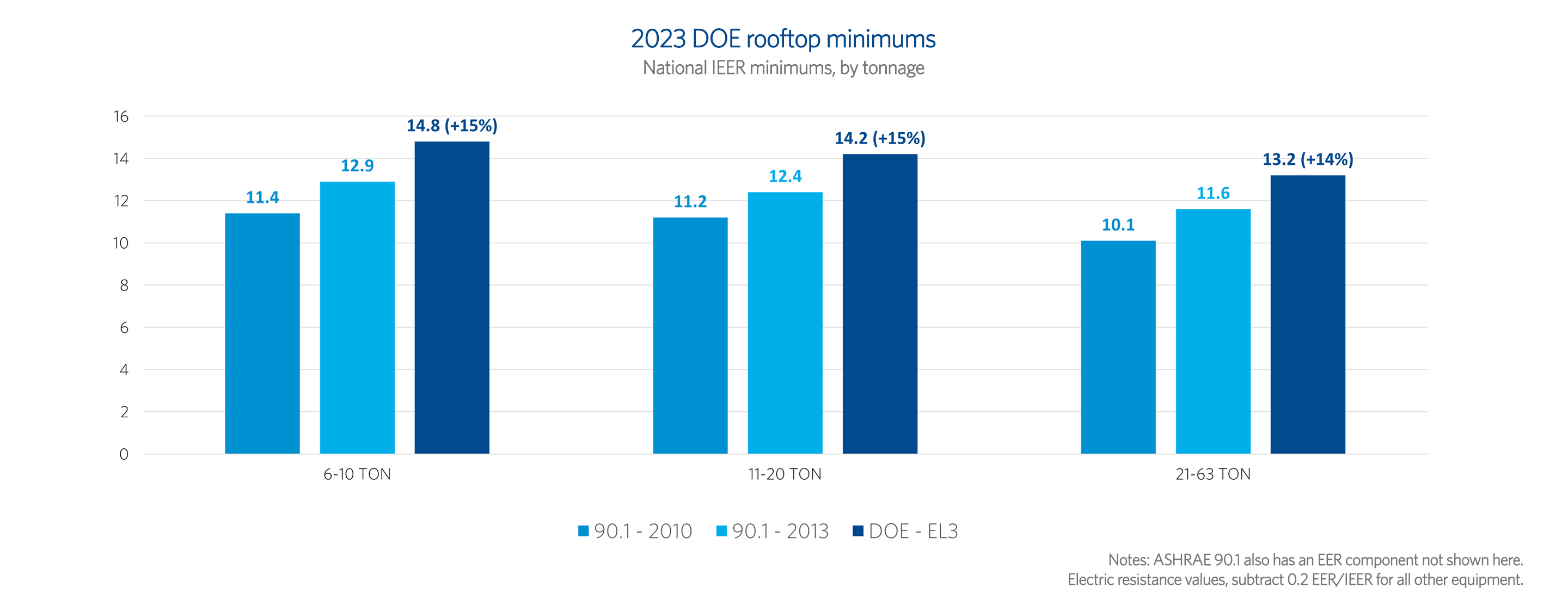
Commercial rooftop efficiency is measured as Integrated Energy Efficiency Ratio (IEER). The current federal minimum efficiency for commercial rooftop units, effective in 2023, is roughly a 15% increase over the 2018 efficiency levels.
What are the current residential air conditioning and heat pump energy efficiency standards?
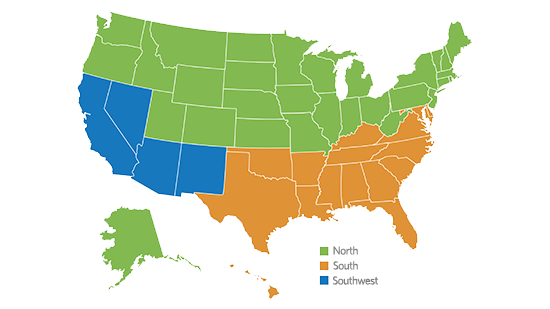
The Appendix M1 table below lists the current DOE minimum efficiency levels for residential air conditioners and heat pumps. These minimums took effect in 2023 and remain the current federal minimums. Along with the increase in efficiency over previous levels, a new test procedure entered into force: 10 CFR Appendix M1 to Subpart B of Part 430, Uniform Test Method for Measuring the Energy Consumption of Central Air Conditioners and Heat Pumps. Systems tested with this method use the nomenclature SEER2, HSPF2 and EER2.
| 2023 – Appendix M1 | All | North | South | Southwest | |
|---|---|---|---|---|---|
| Type | HSPF2 (HSPF) | SEER2 (SEER) | SEER2 (SEER) | SEER2 (SEER) | EER2 (EER) |
| AC < 45K BTU/Hr | - | 13.4 (14) | 14.3 (15) | 14.3 (15) | 11.7 (12.2) / 9.8* (10.2) |
| *NewAC > 45K BTU/Hr | - | 13.4 (14) | 13.8 (14.5) | 13.8 (14.5) | 11.2 (11.7) / 9.8* (10.2) |
| Heat Pump | 7.5 (8.8) | 14.3 (15) | 14.3 (15) | 14.3 (15) | - |
| Packaged Units | 6.7 (8.0) | 13.4 (14) | 13.4 (14) | 13.4 (14) | 10.6 (11) |
*9.8 EER2 limit for equipment ≥ 15.2 SEER2